

Stop Scrolling for a While
In order to scroll better...

Social media is the ultimate enabler of our age.
The average person uses 6 different social media platforms and spends 2.5 hours on them daily. These tools are so deeply embedded in our lives that we rarely step back to see them clearly.
Today we’ll take a step back and examine social media from the outside. We'll develop a simple framework to understand its different types, uses, and limitations.
Firstly, Why Is Social Media Our Biggest Enabler?
Tell me which of these statements isn't true:
You can listen to hundreds of potential customers' problems for free.
You can become a respected expert followed by thousands in just a few months, simply by sharing valuable insights consistently.
You can sell your expertise to anyone, anywhere without travel.
Sounds remarkable when framed this way, doesn't it?
That's why I believe social media outranks even AI as our era's greatest enabler.
But here's the catch: You can't do everything on every platform.
Different platforms enable different opportunities. You need a framework to navigate them effectively.
Let's explore how to think about these platforms so you can choose the right ones for your specific goals.
The 3 Types of Social Media: A Practical Framework
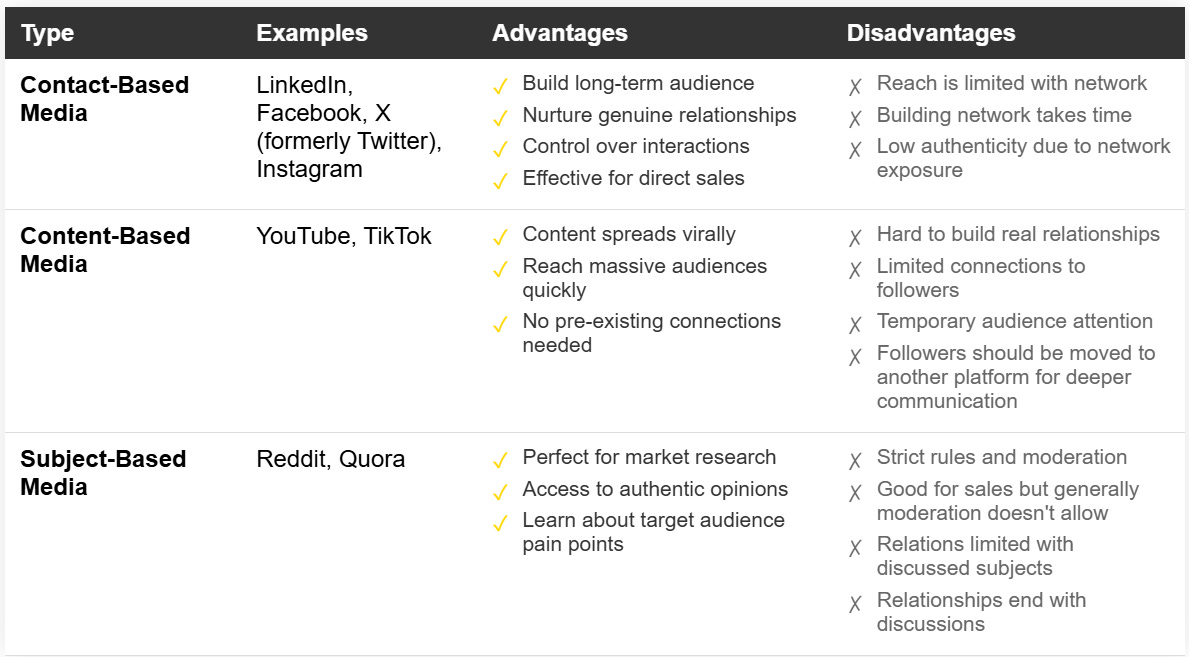
1. Contact-Based Social Media
Think LinkedIn, Facebook, X (formerly Twitter), Instagram.
Built on personal networks, these platforms connect you with specific people whose posts and activities fill your feed. Their power lies in sales potential: you cultivate a long-term audience, nurture genuine relationships, and maintain control over your interactions.
From your desk, you can connect with someone across the world, develop a relationship, and sell your solution—all without a single face-to-face meeting.
Yet two significant downsides exist:
Authenticity suffers as people carefully filter their content. Within networks where reputation matters, everyone manages their image, hiding real problems.
Your reach remains limited. Messages typically stay within your network, and expanding that network demands considerable time and persistent effort.
2. Content-Based Social Media
YouTube and TikTok lead here.
Unlike contact-based platforms, here your content becomes the product. Personal connections? Unnecessary. When your content delivers value, algorithms enthusiastically spread it to the masses.
These platforms work like viral chains. Your content reaches a small group first. If they engage, it spreads further. Then further still.
Good content can make you well-known quickly—even if nobody knew you before.
The downside? It's hard to build real relationships.
Your subscriber count might hit 100,000, yet you'll have no direct connection to these followers. Should your next post fail to engage them, you could disappear from their feeds entirely.
Smart creators use content-based platforms to build awareness, then guide their audience to contact-based platforms where they can build permanent relationships.
3. Subject-Based Social Media
Reddit and Quora stand as prime examples.
On these platforms, people stay anonymous and speak honestly about what they like, hate, and need.
This makes these platforms perfect for market research. You can learn what your audience really wants by reading their complaints, questions, and unsolved problems.
These platforms can actually be great for sales, but they have strict rules and moderation. You'll need to pay for ads or follow their community guidelines carefully.
Don't expect to build lasting relationships here. Conversations are short and focused on subjects. When a discussion ends, the connection usually ends too.
The Emerging Trend: Hybridization
Each platform still maintains its core design, but grows by adding features from other categories.
For example, YouTube introduced channel memberships similar to contact-based features, allowing creators and members to build deeper relationships.
Instagram added Reels, helping content reach beyond your immediate network.
LinkedIn now has subject-based groups where people gather around subjects rather than just their professional connections.
All platforms are adding new features, diversifying their functionality. Yet understanding their core principle remains critical to choose the right one for the right purpose.
Let's finalize with key takeaways on how to utilize this framework in your daily life:
Takeaways:
Want to sell solutions or find a job? Use contact-based social media like LinkedIn. Start today because building a strong network takes time.
Need to build a reputation for your expertise? Try content-based platforms like YouTube. They help you reach more people than contact-based networks can.
Looking for product or marketing ideas? Go to subject-based platforms like Reddit. Find relevant communities and learn what people really think and need.
Look for the new hybrid features that platforms are introducing. Early adopters usually take advantage of low competition to reach their goals.